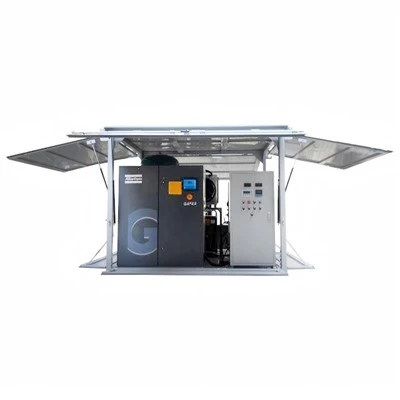

The oil content of the air entering the tower must be controlled below 0.01 ppm; since "oil-free" air compressors cannot guarantee absolute oil-free operation, installing an oil removal device at the dryer inlet is essential to prevent the rapid accumulation of trace oil in the adsorption bed. Heated-regeneration adsorption dryers should be operated within rated temperature and pressure limits; capacity adjustments are required if the inlet temperature exceeds or the inlet pressure falls below the rated values.
When a heated-regeneration adsorption dryer is used in conjunction with a reciprocating air compressor, a stabilizing air receiver tank should be installed upstream to eliminate high-speed airflow pulsations that could impact the adsorbent. Avoid reducing regeneration energy consumption (including regeneration airflow volume and heating power) in a misguided attempt to save energy. If a refrigerated dryer is installed upstream, the heated-regeneration adsorption dryer and the refrigerated dryer should be installed separately whenever space permits; this minimizes air pressure drop, improves ventilation for the refrigerated dryer, and facilitates routine maintenance and servicing. When the air supply capacity is sufficient, a heatless regeneration dryer should be the preferred choice; its overall energy consumption is not higher than that of heated-regeneration models, yet it delivers a lower and more stable dew point.